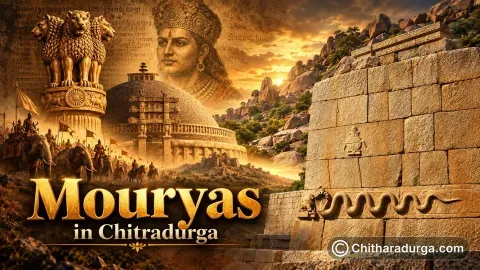

The Mauryan period represents one of the earliest historically documented chapters in the ancient history of Chitradurga. During the 3rd century BCE, parts of present-day Karnataka were connected with the vast Mauryan Empire. The most important evidence for this connection in the Chitradurga region comes from the Ashokan inscriptions discovered at Brahmagiri, Siddapura and Jatinga-Rameshwara.
The Satavahanas were one of the most important dynasties of ancient Deccan India. They rose to power after the decline of the Mauryan Empire and ruled extensive territories of the Deccan for several centuries, broadly between the late centuries BCE and the early centuries CE. During this period, the region corresponding to present-day Chitradurga district became part of the wider political, economic and cultural developments taking place across the Deccan.
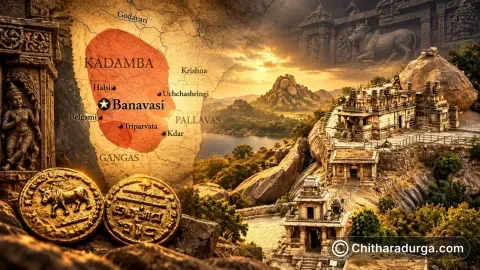
The Kadambas of Banavasi were one of the earliest important native dynasties of Karnataka. Emerging around the 4th century CE, they established an independent kingdom with Banavasi as their principal centre. Their rise marked an important stage in the political and cultural development of ancient Karnataka. The wider region of present-day Chitradurga was influenced by the changing political conditions created by the Kadambas and other contemporary powers.
The ancient history of Chitradurga stretches back many centuries before the rise of its famous fort and the Nayaka rulers. Archaeological remains, inscriptions, ancient settlements and discoveries from places such as Brahmagiri and Chandravalli reveal that the region was inhabited from prehistoric times and later became connected with several important kingdoms of southern India.
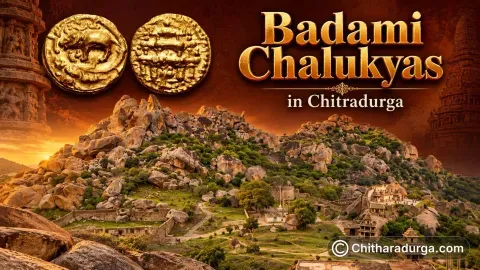
The Badami Chalukyas, also known as the Early Chalukyas of Badami, were one of the most influential dynasties in the early medieval history of Karnataka. From the 6th to the 8th century CE, they established a powerful kingdom across much of the Deccan. The region corresponding to present-day Chitradurga district formed part of the wider political and cultural landscape influenced by the Chalukyas.
The Rashtrakutas were one of the most powerful dynasties of the Deccan and played an important role in the early medieval history of Karnataka. From the 8th to the 10th century CE, their empire extended across large parts of the Deccan and South India. The region corresponding to present-day Chitradurga district formed part of the wider political and cultural landscape influenced by Rashtrakuta authority.
The Kalyani Chalukyas, also known as the Western Chalukyas, were one of the major dynasties that influenced the medieval history of Karnataka. From the late 10th to the 12th century, their power extended across large parts of the Deccan, including areas that form the present-day Chitradurga district. Their period represents an important stage between the earlier Rashtrakuta era and the later rise of the Hoysalas.
The Hoysala dynasty played an important role in the medieval history of Karnataka, and its political and cultural influence extended into parts of the present-day Chitradurga district. During the period of Hoysala expansion, the region formed part of a wider zone connecting central Karnataka with important political centres to the south and west.
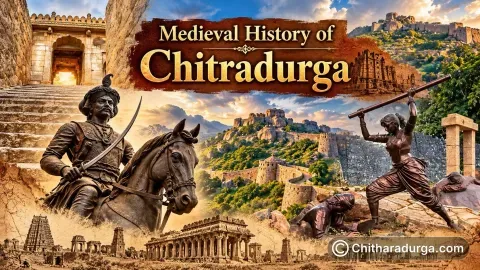
The medieval history of Chitradurga is marked by the rule and influence of several powerful South Indian dynasties, the growth of fortified settlements, and the eventual rise of the Chitradurga Nayakas (Palegars). Its strategic location in central Karnataka and its naturally protected rocky landscape made Chitradurga an important military and administrative centre for centuries.
The Vijayanagara Empire, founded in 1336, became one of the most powerful kingdoms of South India. For more than two centuries, it played a major role in the political, military, economic and cultural history of the Deccan and South India. However, internal rivalries, continuous warfare and the growing power of the Deccan Sultanates gradually weakened the empire.
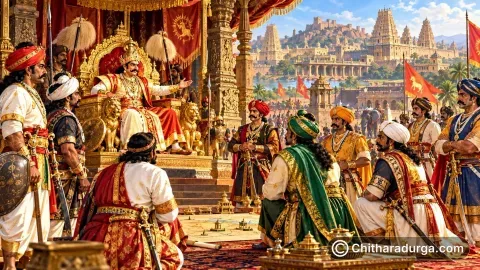
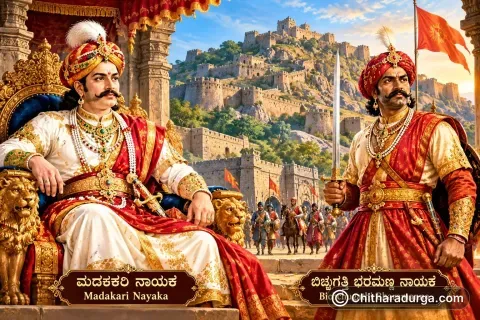
The Chitradurga Nayakas, also known as the Palegars (Paleyagars) of Chitradurga, emerged as an important regional ruling family during the period of the Vijayanagara Empire. Their rise formed an important chapter in the political and military history of central Karnataka.
The Nayakas of Chitradurga played a major role in shaping the political, military and cultural history of central Karnataka. Emerging during the period of the Vijayanagara Empire, the Nayakas gradually established Chitradurga as a powerful regional principality. Over successive generations, they strengthened the famous Chitradurga Fort, developed settlements, encouraged agriculture and water conservation, supported temples and local institutions, and defended their territory against neighbouring