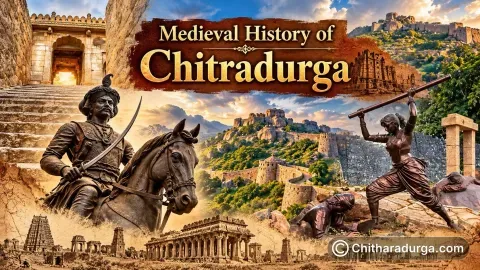

The medieval history of Chitradurga is marked by the rule and influence of several powerful South Indian dynasties, the growth of fortified settlements, and the eventual rise of the Chitradurga Nayakas (Palegars). Its strategic location in central Karnataka and its naturally protected rocky landscape made Chitradurga an important military and administrative centre for centuries.
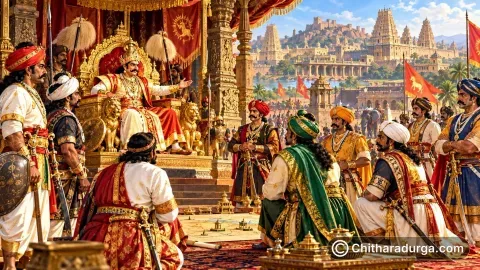
The Vijayanagara Empire, founded in 1336, became one of the most powerful kingdoms of South India. For more than two centuries, it played a major role in the political, military, economic and cultural history of the Deccan and South India. However, internal rivalries, continuous warfare and the growing power of the Deccan Sultanates gradually weakened the empire.
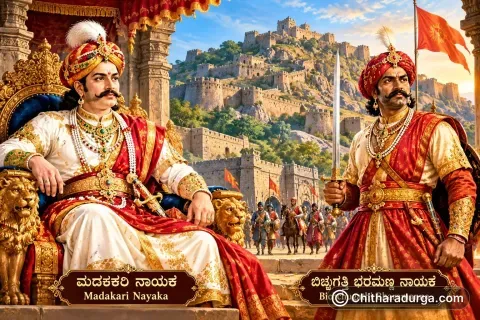
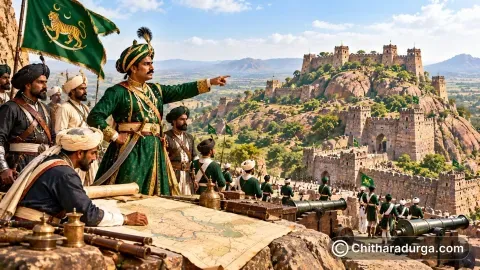
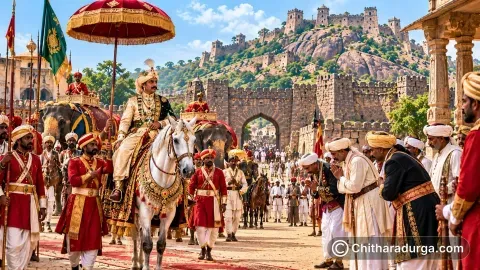
The Chitradurga Nayakas, also known as the Palegars (Paleyagars) of Chitradurga, emerged as an important regional ruling family during the period of the Vijayanagara Empire. Their rise formed an important chapter in the political and military history of central Karnataka.
The Nayakas of Chitradurga played a major role in shaping the political, military and cultural history of central Karnataka. Emerging during the period of the Vijayanagara Empire, the Nayakas gradually established Chitradurga as a powerful regional principality. Over successive generations, they strengthened the famous Chitradurga Fort, developed settlements, encouraged agriculture and water conservation, supported temples and local institutions, and defended their territory against neighbouring
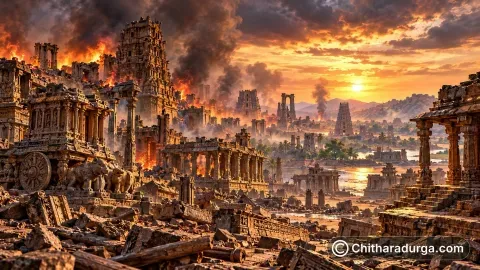
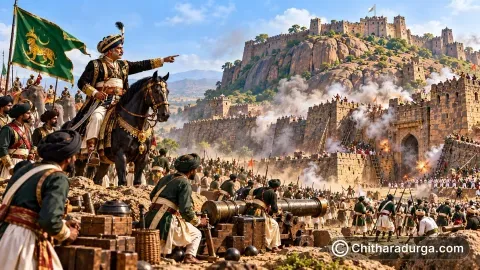
The capture of Chitradurga by Hyder Ali in 1779 was one of the most decisive events in the history of central Karnataka. It brought an end to the long rule of the Chitradurga Nayaka dynasty and incorporated the strategically important Chitradurga region into the expanding Kingdom of Mysore.
The history of Tipu Sultan and Chitradurga belongs to an important period of political and military change in Karnataka during the late eighteenth century. Chitradurga, which had flourished for generations under its powerful Nayaka rulers, became part of the expanding Mysore kingdom in 1779, when Hyder Ali, father of Tipu Sultan, captured the famous Chitradurga Fort from the last Nayaka ruler, Madakari Nayaka V.
The history of Chitradurga during the Mysore Wodeyars period represents an important transition from the age of the Chitradurga Nayakas to a more centralised system of administration under the Mysore State. During the nineteenth and early twentieth centuries, Chitradurga gradually developed through changes in administration, agriculture, irrigation, education, transport and public institutions.
Among the many historical treasures of Chitradurga district, Brahmagiri and Ashoka Siddapura hold a special place. Located near Molakalmuru in Chitradurga district, Karnataka, this region preserves archaeological evidence that connects the district with the Mauryan Empire and Emperor Ashoka, taking its recorded history back more than two thousand years.
The British period was an important phase in the transformation of the education system in Chitradurga district. During the nineteenth and early twentieth centuries, education gradually moved from traditional village-based learning towards a more organised system of primary schools, government-supported institutions, examinations and formal curricula.
The British period marked an important stage in the development of transport and communication in Chitradurga. Before modern roads and motor vehicles became common, people largely depended on bullock carts, horse-drawn transport, pack animals and walking for travel and the movement of goods.
The British period brought major changes to the political and administrative structure of Chitradurga. After the fall of the Chitradurga Nayakas in the eighteenth century, the region passed through the control of Hyder Ali and Tipu Sultan of Mysore before coming under British authority following the Fourth Anglo-Mysore War in 1799.
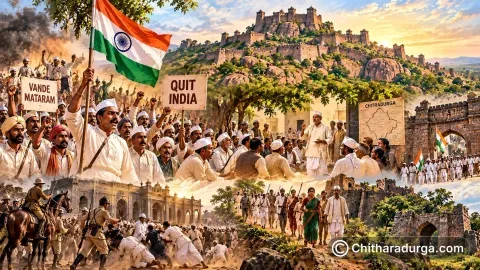
Chitradurga in India's Freedom StruggleChitradurga, historically celebrated as a land of courage, sacrifice and resistance, played a meaningful role in India’s freedom struggle. The district that had once witnessed the…