 By Raghavendra Padmashali

Early Kingdoms in Chitradurga
The ancient history of Chitradurga stretches back many centuries before the rise of its famous fort and the Nayaka rulers. Archaeological remains, inscriptions, ancient settlements and discoveries from places such as Brahmagiri and Chandravalli reveal that the region was inhabited from prehistoric times and later became connected with several important kingdoms of southern India.
Situated in the heart of Karnataka, Chitradurga occupied a strategic position between the northern Deccan and southern Karnataka. Its rocky hills, valleys, water sources and routes of communication encouraged the development of settlements and brought the region under the influence of different political powers over the centuries.
Mauryan Influence and Ashoka
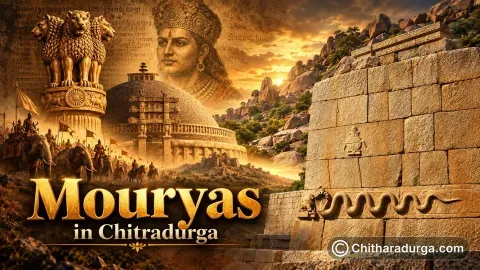
One of the earliest historically documented political influences in the Chitradurga region is associated with the Mauryan Empire. The discovery of Ashokan inscriptions at Brahmagiri, Siddapura and Jatinga-Rameshwara provides important evidence of Mauryan presence or authority in this part of Karnataka during the 3rd century BCE.
These inscriptions, issued during the reign of Emperor Ashoka, demonstrate that the region was connected to the administrative and cultural world of the Mauryan Empire. They are among the most important archaeological sources for understanding the early recorded history of Chitradurga.
Satavahanas and Chandravalli
After the decline of Mauryan power, the Deccan witnessed the rise of the Satavahanas. Archaeological discoveries at Chandravalli, near Chitradurga, indicate that the settlement developed into an important centre of habitation and exchange during the early historic period.
Excavations at Chandravalli have revealed pottery, coins, beads and other antiquities that indicate connections with wider trade networks. The archaeological evidence shows that ancient Chitradurga was not an isolated region but participated in the economic and cultural developments taking place across the Deccan.
Kadambas and Gangas
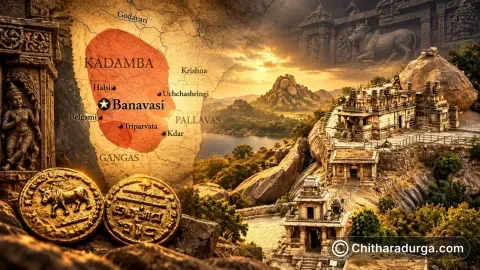
In the centuries that followed, parts of central Karnataka came under the influence of regional dynasties such as the Kadambas of Banavasi and the Western Gangas. These kingdoms contributed to the development of regional administration, agriculture, religious institutions and Kannada culture.
Local chiefs and smaller political centres also played an important role in administering territories. This pattern of regional and local governance became an important feature of Karnataka's political history.
Growth of Settlements and Agriculture
The early kingdoms contributed to the gradual transformation of Chitradurga from scattered ancient settlements into an increasingly organized agrarian region. Villages developed around cultivable lands, tanks, streams and other water sources.
Agriculture, cattle rearing, crafts and local trade formed important parts of everyday economic life. Routes passing through central Karnataka connected settlements in the Chitradurga region with other parts of the Deccan and southern India.
Religion and Cultural Development
Ancient Chitradurga witnessed the influence of different religious traditions. The Ashokan inscriptions provide evidence of the spread of Buddhist ideas during the Mauryan period, while later centuries saw the growth of Hindu and Jain traditions.
Temples, religious establishments, inscriptions and local traditions gradually became part of the cultural landscape. The interaction of different beliefs and communities contributed to the diverse heritage of the region.
Archaeological Importance of Chitradurga
Sites such as Brahmagiri and Chandravalli are especially important for reconstructing the ancient history of Chitradurga. Archaeological excavations have revealed evidence belonging to different stages of human occupation, helping historians trace the region's development from prehistoric communities into organized historical societies.
Brahmagiri is particularly significant for its prehistoric remains and Ashokan inscriptions, while Chandravalli provides evidence of an important early historic settlement with wider commercial and cultural connections.
Transition towards the Medieval Period
Over the centuries, the political landscape of Karnataka continued to change. Early regional kingdoms were followed by larger dynasties that exercised authority over central Karnataka. The Badami Chalukyas eventually emerged as a major power, followed by the Rashtrakutas, Kalyani Chalukyas and Hoysalas.
In later centuries, the region became associated with the Vijayanagara Empire, and eventually the Chitradurga Nayakas developed Chitradurga into the celebrated fortified centre for which it is widely known today.
Legacy of the Early Kingdoms
The early kingdoms laid important foundations for Chitradurga's later historical development. They contributed to the growth of administration, agriculture, settlements, trade, religion and regional culture.
The Ashokan inscriptions of the Brahmagiri region, the archaeological wealth of Chandravalli and the remains of ancient settlements demonstrate that Chitradurga's history extends far beyond its famous medieval fort.
Thus, the story of ancient Chitradurga is one of continuous human settlement, changing kingdoms and cultural interaction—a long historical journey that eventually shaped the distinctive identity of the Land of Valour.