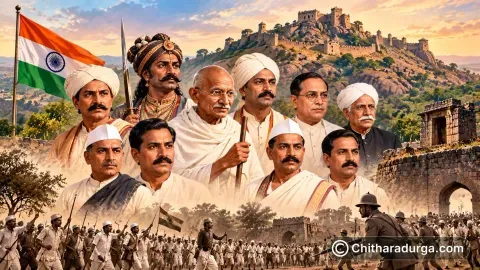
Chitradurga is widely remembered as the land of courage and resistance. Centuries before India's modern freedom movement, the region had witnessed the valour of the Nayaka rulers and legendary figures such as Onake Obavva. During the twentieth century, this tradition of resistance took a new form as people of Chitradurga joined the national struggle against colonial rule.
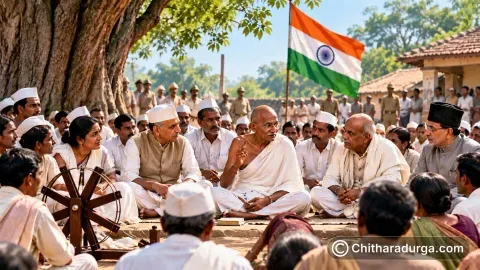
The Gandhian Movement in Chitradurga district occupies an important place in the region’s modern history. During India’s freedom struggle, Mahatma Gandhi’s principles of Satyagraha, Ahimsa, Swadeshi, Khadi, prohibition, social equality, simplicity and village upliftment inspired political workers, teachers, students, women and ordinary villagers across the region.
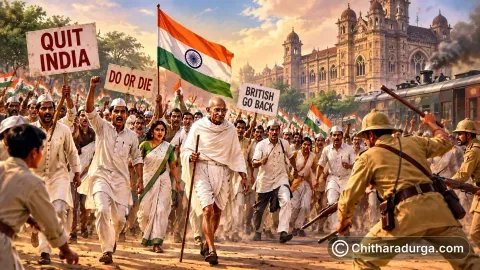
The Quit India Movement of 1942 was one of the most decisive phases of India's struggle for independence, and Chitradurga district was among the active centres of the movement in the then princely State of Mysore. Historical accounts of the freedom struggle in Karnataka identify Chitradurga alongside Mysore, Bangalore, Tumkur, Dharwad, Belgaum and other important centres where the movement generated considerable political activity.
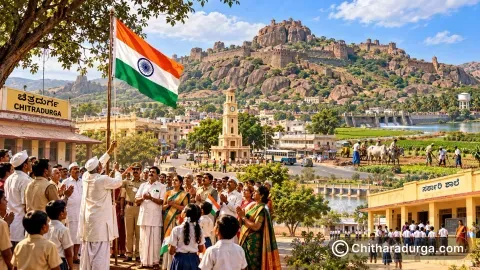
When India attained independence on 15 August 1947, the Chitradurga region stood at an important point of transition. A land known for its formidable fort, Nayaka rulers, warrior traditions and historic resistance, Chitradurga was entering a new democratic era after centuries of changing political rule.
Chitradurga District has a diverse population shaped by its long history, predominantly rural economy, agricultural traditions, border-region cultural influences and steadily developing urban centres. Spread across six taluks — Chitradurga, Challakere, Hiriyur, Holalkere, Hosadurga and Molakalmuru — the district brings together communities with different occupations, traditions, languages and ways of life.
Chitradurga District has a well-established administrative network connecting the district headquarters, six taluks, urban local bodies and villages. Government offices at different levels are responsible for revenue administration, rural and urban development, law and order, agriculture, healthcare, education, social welfare, transport, infrastructure and a wide range of citizen services.
Urban administration plays an important role in the development and day-to-day management of towns and cities across Chitradurga District. While Gram Panchayats and other Panchayat Raj institutions serve rural areas, urban settlements are administered through Urban Local Bodies (ULBs) constituted under Karnataka's municipal administration system.
The Hobli is an important unit of revenue administration in Karnataka, functioning between the Taluk and Village levels. Chitradurga District is divided into 6 taluks and 22 hoblis, which together provide an organised administrative framework for hundreds of villages across the district.
Chitradurga District has 189 Gram Panchayats, distributed across its six taluks. The following tables provide the complete taluk-wise list of Gram Panchayats for easy reference.
Chitradurga District has 189 Gram Panchayats, distributed across its six taluks — Chitradurga, Challakere, Hiriyur, Holalkere, Hosadurga and Molakalmuru. A Gram Panchayat may cover a single village or a group of villages notified under the Panchayat Raj framework.
Chitradurga District, located in central Karnataka, is administratively divided into six taluks — Chitradurga, Challakere, Hiriyur, Holalkere, Hosadurga and Molakalmuru. Together, these taluks cover the district's total geographical area of approximately 8,436 square kilometres and form an important link between the district administration and villages.
The District Administration of Chitradurga is the principal administrative machinery responsible for implementing government policies, maintaining revenue administration, coordinating development programmes and delivering essential public services throughout the district. Chitradurga city serves as the district headquarters and houses the Deputy Commissioner’s Office and several important district-level government departments.