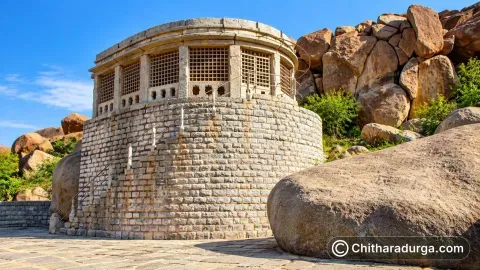
Madakari Nayaka – The Last Lion of Chitradurga and the Final Years of the Nayaka Kingdom
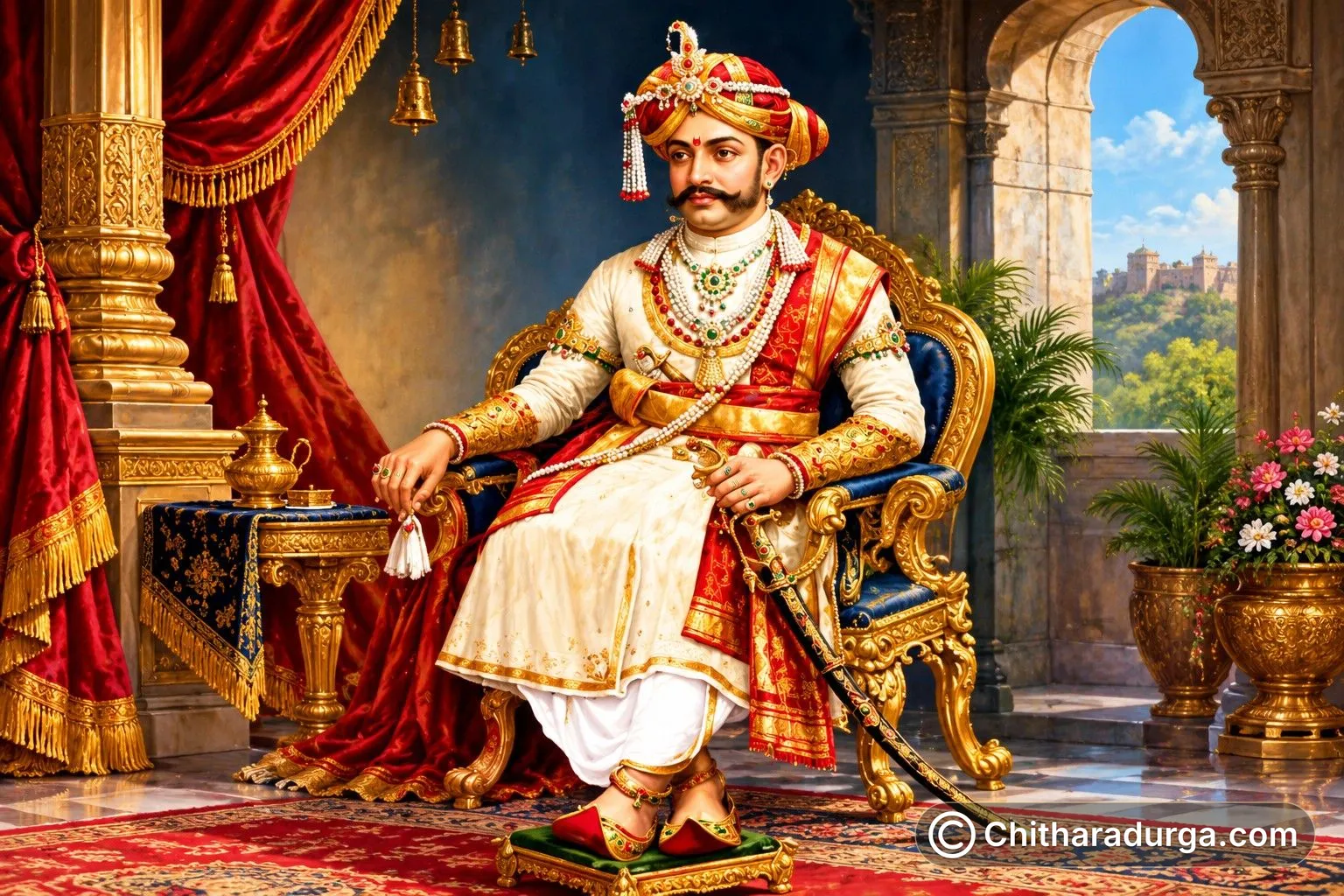
Madakari Nayaka – The Last Lion of Chitradurga and the Final Years of the Nayaka Kingdom
Among the many rulers whose stories are carved into the rocky landscape of Chitradurga, few occupy a place as powerful as Madakari Nayaka V, the last ruler of the Chitradurga Nayakas.
His reign marked both the height of Chitradurga's struggle for political survival and the final chapter of a Nayaka kingdom that had dominated the region for generations. From the massive walls of Chitradurga Fort, Madakari Nayaka attempted to preserve his kingdom while two powerful forces—the Marathas and Hyder Ali of Mysore—competed for influence across southern India.
The struggle ended dramatically in 1779, when Chitradurga Fort fell to Hyder Ali and the independent rule of the Nayakas came to an end.
Yet the fall of the kingdom did not erase Madakari Nayaka from history.
Instead, he became one of the most enduring symbols of Chitradurga's courage, resistance and pride.
The Rise of the Chitradurga Nayakas
The history of the Chitradurga Nayakas began under the wider political authority of the Vijayanagara Empire.
Local chiefs gradually established themselves in the region, and Chitradurga developed into their principal stronghold. After the decline of Vijayanagara, the Nayakas consolidated their authority and emerged as an important regional power.
For generations they strengthened Chitradurga Fort, constructed gateways, bastions, tanks, temples and other structures, and built a kingdom around one of southern India's most formidable natural fortresses.
Among the important rulers of the dynasty, Bharamappa Nayaka is particularly remembered for strengthening the kingdom and undertaking extensive building activities.
By the eighteenth century, however, the political environment surrounding Chitradurga had become increasingly dangerous.

Madakari Nayaka – The Final Ruler
Madakari Nayaka V emerged as the last ruler of the Chitradurga Nayaka kingdom in the mid-eighteenth century.
He inherited a kingdom with a formidable fortress and a strong warrior tradition, but also one surrounded by ambitious powers.
The eighteenth-century Deccan was undergoing rapid political change. The weakening of older political structures created competition among the Marathas, Mysore, the Nizam and numerous regional chiefs.
Chitradurga stood directly within this struggle.
Madakari Nayaka therefore had to be more than a warrior. He needed to be a diplomat, strategist and survivor.
Between Hyder Ali and the Marathas
One of the greatest challenges of Madakari Nayaka's reign was maintaining Chitradurga's independence while balancing relations with Hyder Ali of Mysore and the Marathas.
At different stages Madakari cooperated with Hyder Ali and assisted him in military campaigns. At other times, political circumstances pushed Chitradurga toward the Marathas.
These changing alliances were not simply matters of friendship or betrayal. They reflected the difficult reality faced by a comparatively smaller kingdom caught between stronger competing powers.
Every alliance involved risk.
Supporting one side could immediately turn the other into an enemy.
Madakari Nayaka's final years were therefore marked by constant political calculation and military pressure.
Chitradurga Fort – The Kingdom's Greatest Weapon
Madakari Nayaka possessed one enormous advantage:
Chitradurga Fort.
Its massive granite hills, multiple defensive walls, narrow gateways, bastions, hidden passages, water systems and difficult terrain made it one of the strongest hill fortresses in the region.
The fort was more than Madakari's capital.
It was his shield.
The Nayakas had spent generations integrating natural boulders with military architecture. An attacking army had to penetrate successive defensive lines while fighting through unfamiliar rocky terrain.
Madakari used this formidable fortress to resist repeated pressure from Hyder Ali. Historical accounts describe several confrontations and sieges before the decisive campaign of 1779.
The Shadow of Hyder Ali
By the later eighteenth century, Hyder Ali had transformed Mysore into one of southern India's strongest military powers.
For Hyder, Chitradurga was strategically important.
A strong and independent Nayaka kingdom could obstruct Mysore's influence toward central and northern Karnataka. Controlling Chitradurga would also secure an important fortress and strengthen Mysore's regional position.
The conflict therefore became increasingly difficult to avoid.
Madakari Nayaka's efforts to navigate between Mysore and the Marathas eventually brought Chitradurga into direct confrontation with Hyder Ali.
The Siege of Chitradurga
The final struggle was not a single dramatic battle fought in one afternoon.
It was the culmination of years of political rivalry, military pressure, shifting alliances and repeated confrontation.
Hyder Ali's forces surrounded Chitradurga and placed enormous pressure on the fortress. Madakari Nayaka and his defenders relied on the strength of the fort, its stored resources and its extraordinary defensive geography.
The siege continued for months in its final phase.
Chitradurga resisted—but the balance of power was turning against the Nayakas.
Onake Obavva – Courage Amid the Conflict
The turbulent final period of the Nayaka kingdom is also associated in popular tradition with the legendary courage of Onake Obavva.
According to the celebrated story, enemy soldiers attempted to enter through a narrow opening between the rocks while her husband, a fort guard, was away from his post.
Obavva noticed them and used an onake, the long wooden pestle used for pounding grain, to confront the soldiers entering one at a time.
The opening became famous as Obavvana Kindi.
The precise chronology and details of the story vary across retellings, so it is best understood as a deeply rooted historical tradition rather than treating every detail as firmly documented fact.
Yet its cultural significance is unquestionable.
Madakari represents the resistance of a kingdom.
Obavva represents the courage of its ordinary people.
Together, their stories became inseparable from the identity of Chitradurga.
The Last Days of the Kingdom
By 1779, Chitradurga's position had become extremely difficult.
The expected balance of alliances did not save the kingdom. Historical accounts also describe disaffection and defections among some people within Madakari's service during the final crisis.
After months of resistance, Hyder Ali finally succeeded in capturing Chitradurga Fort in 1779.
The fall of the fort meant far more than the loss of a military position.
It brought to an end the political sovereignty of the Chitradurga Nayakas, whose rule had shaped the region for roughly two centuries.
Madakari Nayaka's Capture
After the fall of Chitradurga, Madakari Nayaka and members of his family were taken prisoner and sent to Srirangapatna.
Historical traditions and later accounts differ on some details surrounding his final days, but his political career ended with the capture of his kingdom.
The ruler who had commanded one of Karnataka's greatest fortresses was now a prisoner.
For Chitradurga, it was truly a Durga Astamana—the setting of the fortress kingdom.
The End of the Nayaka Kingdom
The fall of Chitradurga in 1779 marked the end of an era.
For generations the Nayakas had transformed a landscape of enormous granite hills into the centre of a powerful regional state.
They built and strengthened fortifications.
They constructed tanks and temples.
They fought neighbouring powers.
They created a political identity centred on Chitradurga.
With Madakari's defeat, that independent political world disappeared.
Chitradurga passed under Hyder Ali's control, and later remained associated with Mysore through the period of Tipu Sultan and subsequent political changes.
Madakari Nayaka in Kannada Memory
Madakari Nayaka did not disappear with his kingdom.
His life and the fall of Chitradurga became powerful subjects in Kannada literature, folklore and historical imagination.
One of the most celebrated literary works associated with this story is Ta. Ra. Su.'s Durgastamana, a historical novel centred on the final phase of the Nayaka kingdom and Madakari Nayaka. The work later received the Sahitya Akademi Award posthumously for its author.
Through literature, theatre, folklore and public memory, Madakari's story has continued across generations.
A King Remembered with His Fort
Few rulers are identified with their capital as strongly as Madakari Nayaka is with Chitradurga.
To remember Madakari is to remember the massive walls of the fort.
To remember the fort is to remember the final resistance of the Nayakas.
The landscape itself seems to preserve the story—gateways that once guarded a kingdom, bastions from which soldiers watched the horizon, reservoirs that sustained people during sieges and enormous rocks that served as natural walls.
Today they stand silently.
But they continue to tell the story of a kingdom that refused to surrender easily.
Madakari Nayaka – The Last Chapter of a Warrior Kingdom
Madakari Nayaka's story is ultimately not only about defeat.
It is about a ruler attempting to preserve a smaller kingdom during one of the most turbulent periods in southern Indian history.
He fought when war became unavoidable.
He negotiated when diplomacy offered survival.
He relied on one of India's most extraordinary fortresses.
And when Chitradurga finally fell in 1779, more than a ruler lost his throne—the centuries-old political era of the Chitradurga Nayakas came to an end.
The kingdom disappeared, but its memory survived in stone.
Madakari Nayaka remains the last great symbol of that world—the ruler whose final struggle became forever intertwined with the courage, tragedy and pride of Chitradurga.